


Michael Sullivan is a writer covering kitchen equipment and tableware. He has broken more than a hundred drinking glasses to find the most durable.
Peppercorns were once so prized, they were the preferred currency of wealthy medieval Europeans. Now, people mostly take them for granted, which is surely helped by the fact that the bland, pre-ground pepper in the spice aisle is a far cry from the freshly ground version that had bygone nobility abuzz. The powdery stuff is fine at a diner, but at home you deserve better. Since the flavor and fragrance of pepper are fleeting, grinding it fresh is the only way to capture and relish its true piquancy.
Enter the pepper mill. A good one will instantly enhance the flavor of your food by releasing intensely aromatic oils from the peppercorns as it grinds.
After testing over 40 mills over the course of a decade, we have lots of recommendations — whether you’re looking for something classic or something more visually striking that will make a statement on your table or kitchen counter. Though our picks range in price and design, they have one thing in common: They should last for decades if you properly care for them.
If you have difficulty twisting traditional hand-crank pepper mills, we also recommend a number of styles that may be easier for you to operate based on your needs.
The research
Why you should trust us
I’m a writer at Wirecutter covering kitchen equipment and tabletop items. Since 2015 I’ve tested all kinds of products from toaster ovens to drinking glasses. I’ve spent dozens of hours researching, testing, and cranking pepper mills to find the best.
For this guide:
- We’ve conducted over 80 hours of research and tested over 40 pepper mills.
- To learn more about what makes a great pepper mill, we spoke with a spice merchant, cookbook authors, and chefs.
- Like all Wirecutter journalists, we review and test products with complete editorial independence. We’re never made aware of any business implications of our editorial recommendations. Read more about our editorial standards.
Who should get a pepper mill
If you’ve been using pre-ground pepper from a can (no judgement), switching to freshly ground pepper is a noticeable upgrade. That said, if you have limited grip strength and hand dexterity, ground pepper may be the most convenient option.
Those overpriced pre-filled pepper grinders from the supermarket are fine to use for camping, but they have inferior grind mechanisms made of plastic. Using a mill with sharp steel or ceramic grind mechanisms will be easier to crank, give you a much finer grind, and last for decades.
A pepper mill allows you to choose the type of pepper you want to use, which will also save you money in the long run.
If you already own a pepper mill, but it clogs easily or grinds inconsistently, it’s probably time to upgrade.
A classic design: Peugeot Paris u’Select Pepper Mill
Top pick
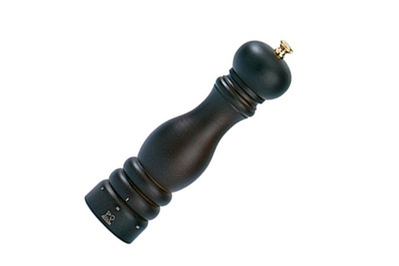
Peugeot pepper mills have been popular since their introduction more than a century ago, and this model is still among the best we’ve tested due to its ease of use, even grind, and classic look.
The Peugeot Paris u’Select Pepper Mill has been a Wirecutter pick since 2015. Peugeot has a long history making mills — its first table pepper mill was introduced in 1874 — and this particular model has long been adored by professional cooks and design enthusiasts alike for its handsome looks and inimitably sharp, case-hardened steel grind mechanism. Due to the design of the mill’s burrs, it’s suitable only for peppercorns, not salt.
It’s easy to use. The head of the mill is easy to twist, and the hourglass shape is comfortable to hold with your anchoring hand. Instead of fiddling with a hard-to-predict screw at the top, you can twist a discreet dial on the bottom of the body to lock in one of six precise fineness settings.
The grind is very consistent. The finer settings didn’t produce any peppercorn chunks, and the coarser settings produced only a little dust.
It’s available in various finishes. The Peugeot Paris u’Select is available in several sizes, colors, and finishes (though we found the stainless steel and high-gloss versions were more difficult to use with wet or greasy hands). If you like the design but prefer adjusting the grind setting using a screw at the top of the grinder instead of a dial on the base, we recommend getting the Paris Pepper Mill.
It has a generous warranty. The burr mechanism comes with a lifetime warranty, and the mill body has a two-year warranty. The mill is made in France, and the wood is sourced from PEFC-certified forests.
Flaws but not dealbreakers
It takes some effort to fill. The 1-inch shaft opening is narrower than that of some of our other picks, so you have to fill the mill more slowly to prevent the peppercorns from bottlenecking around the spindle guard (but we have tips for making it easier).
It may not shift smoothly between grind sizes. It’s sometimes hard for the burrs to catch hold of the peppercorns when switching from fine to coarse. If this happens, holding the mill vertically (instead of at an angle) should solve the issue.
This mill is best if you prefer a fine-to-medium coarse grind. It’s not great at producing crack-between-your-teeth coarse pepper.
Mid-century modern style: Fletchers’ Mill Border Grill Pepper Mill
Top pick

This stylish mill offers a similar performance to the Peugeot Paris u’Select and boasts a solid build. But it lacks preset coarseness settings.
(price varies by color)
It has a sleek, mid-century modern aesthetic. The Fletchers’ Mill Border Grill Pepper Mill offers very similar performance to the Peugeot Paris u’Select Pepper Mill but with a simpler, updated design.
It grinds consistently and impressively evenly. The steel isn’t case-hardened like the Peugeot mill’s grinding mechanism, but it’s sharp and achieves similar results.
The grind mechanism on the Border Grill mill also comes with a limited lifetime guarantee. And like the Peugeot Paris u’Select, it has been a pick since 2014.
It’s made in the US. This model is made in New Vineyard, Maine, from New England hardwoods. It’s available in several colors and three stain options: cherry, mahogany, and walnut.
Flaws but not dealbreakers
It’s slow to fill. The mill’s shaft opening is 0.25-inch wider in diameter than the Peugeot Paris u’Select, so it’s a bit easier to fill with peppercorns. Like the Peugeot model, however, the plastic guard that holds the spindle in place causes a buildup of peppercorns when filling, so you have to add them slowly.
Streamlined and minimalist: Peugeot Boreal Manual Beech Wood Pepper Mill
Top pick
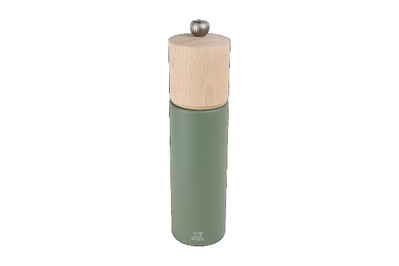
This model offers a simple, pared-down look, and it’s available in several colors.
It has a modern silhouette. On the inside, the Peugeot Boreal Manual Beech Wood Pepper Mill has the same case-hardened grind mechanisms as the Peugeot Paris u’Select we recommend. But on the outside, its pared down column shape gives it a completely different look. Unlike the Paris u’Select, however, it doesn’t have a dial with preset coarseness settings — you adjust the grind size by adjusting a screw on top of the mill.
It grinds quickly. Using roughly the equivalent coarse grind setting, the Boreal mill ground ¼ teaspoon of pepper in fewer twists than the Paris u’Select.
It has a great warranty. The mill parts come with a five-year warranty, and the grind mechanism has a limited lifetime warranty. The wood for the Boreal mill is sourced from French PEFC-certified forests. And though there’s no plain wood option, you can choose from several attractive, muted colors.
Flaws but not dealbreakers
It’s slightly annoying to fill. The opening where you fill the pepper mill shares the same 1-inch diameter as the Peugeot Paris u’Select we recommend. However, this model has a plastic collar that extends past the lip of the shaft, which makes it a bit more difficult to add peppercorns.
The matte finish may show greasy fingerprints. This was at least the case on the gray color we tested.
Lightweight and colorful: CrushGrind Billund Mill
Top pick
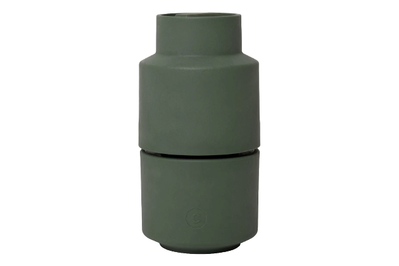
This small, lightweight mill grinds finely and consistently. It comes in a plethora of colors, too.
It’s available in a spectrum of colors. If you want your pepper mill to complement your kitchen appliances or cookware, chances are the CrushGrind Billund Mill comes in the shade you need.
It’s small and lightweight. Measuring about 4.75 inches high and weighing just 4.2 ounces when filled with peppercorns, this mill was the lightest mill we tried. Since it’s so compact, this mill would also be suitable for tossing in a bag and taking to a rental house or on a camping trip.
Despite the size, it holds a lot. With enough space for 2 ounces of peppercorns, it boasts among the largest capacity of the models we tested, so you don’t need to refill it as often.
The ground pepper had an even texture. The Billund Mill grinds on the finer side — the difference in the grind size when adjusting from fine to coarse is minimal.
It’s versatile. Since the grind mechanisms are made of ceramic, the Billund Mill can also be used to grind salt and dried herbs (salt can corrode steel burrs, but not ceramic).
It’s less messy than other mills. The Billund Mill is intended to be stored grinder side up to prevent pepper dust from dirtying your counter or table.
It’s surprisingly durable. It rolled off the counter onto a cement floor during our tests and didn’t chip or crack despite being made from bicomposite plastic. And the grind mechanism comes with a 25-year warranty.
It’s speedy at grinding peppercorns. The Billund Mill ground pepper nearly twice as fast as the Peugeot Paris U’Select mill we recommend, and the screw to adjust the coarseness twists easily, requiring little effort to turn it.
Flaws but not dealbreakers
It’s not always easy to use. Testers with smaller hands felt the circumference of the mill was a bit too wide, though the wider circumference does provide a generous opening for filling.
The silicone plug was difficult to remove when first filling the mill, but it became more pliable with continued use.
And we noticed it becomes a bit difficult to twist when operating with greasy hands.
Charming Danish design: Fritz Hansen Hammer Grinder
Top pick
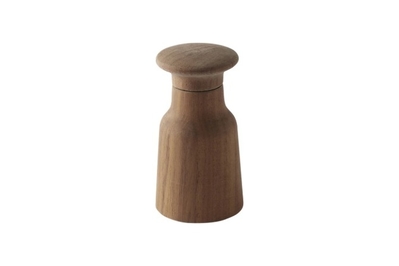
This little but mighty pepper mill looks stylish on a kitchen counter or a dining table.
The Fritz Hansen Hammer Grinder, designed by Christoffer Harlang, has a lovely Danish modern aesthetic that appealed to many of our testers. At 4.75 inches high, it’s the ideal mill for keeping on a dining table — it’s stylish, yet unobtrusive.
It can be used for salt or pepper. The ceramic grind mechanism, made by CrushGrind, makes quick work of grinding, too — it’s nearly twice as fast as the Peugeot Paris u’Select model we recommend.
Its wide, flat knob was easy to grasp. However, some testers with smaller hands felt it dug into their palms and was more uncomfortable to use than mills with rounded knobs.
Refilling the mill is easy. The shaft opening is just over an inch wide in diameter, and the plastic guard that holds the spindle in place is positioned lower in the shaft; peppercorns don’t jam up near the opening as they do on some other models.
The grinder is made in Denmark. It comes in two finishes: untreated oak (which is FSC-certified) and oiled teak. We tested the teak version, and it was sanded to an impressively smooth finish.
Note: If you purchase the pepper mill through Finnish Design Shop, it covers the cost of shipping duties to the US.
Flaws but not dealbreakers
It needs to be refilled more often. This mill’s smaller size holds roughly 2 tablespoons of peppercorns, which is the smallest capacity of our picks. For comparison, the Peugeot Paris u’Select holds double that amount.
It doesn’t grind quite as fine as some of our other picks. But overall we found the coarseness settings to be consistent with the actual grind size.
Sleek and easy to grip: R+D Lab Trulli Mill
Top pick
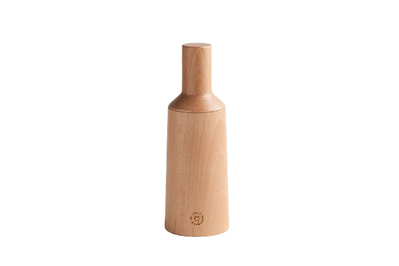
This bottle-shaped mill has a narrower knob that may be easier for some people to grasp and turn.
It’s both modern and practical. The R+D Lab Trulli Mill has a unique bottle-shaped design with a wide tapered base that’s more stable and less likely to take a tumble off the counter if it’s hit with an errant elbow. The narrow knob may also be easier for some people to grip and turn.
The design is not just functional but stylish, and the mill is available in five finishes: legno (beechwood), olive wood, black, alpi green, and ash gray.
It grinds evenly. The ceramic grind mechanism, made by CrushGrind, produces evenly ground pepper whether it’s set to fine or coarse.
It pulls apart. Since this mill lacks a nut at the top for securing the knob, you can just pull the handle straight off to access the inner chamber. The wide 1.5-inch-diameter shaft opening and low spindle bracket make it very easy to fill.
The grind mechanism has a 25-year guarantee. Aside from that, according to R+D Lab, the Trulli Mill is handmade in Italy from sustainably harvested European beechwood.
Flaws but not dealbreakers
Occasionally the knob can start to separate from the body of the mill. Just push the knob back down if you notice this happening.
An easy-on-the-wrists ratchet: Kuhn Rikon Adjustable Ratchet Grinder
Top pick

This ratchet mill is easy to grasp, and it grinds pepper when you move the lever back and forth, so it may be gentler on your wrists.
It requires little wrist movement to operate. The Kuhn Rikon Adjustable Ratchet Grinder has a narrow ratchet handle that grinds when you move it back and forth. It was easy for many of our testers to grasp, and some found it to be far more convenient to operate than mills with traditional twist-style knobs, or even electric models that were difficult to fill with peppercorns.
It’s lightweight. It’s not quite as light as the CrushGrind Billund Mill we recommend, but our testers said it didn’t make their wrists tired. But some said they would need to grind the pepper on a counter for added stability, versus holding the mill over a pot and grinding directly over it.
The side spout makes it easy to fill. Many of our paid testers found that filling the chamber with peppercorns using the spout on the side of the mill was easier than filling most traditional models, which have a narrow opening at the top of the chamber.
It’s the least expensive mill we recommend. At the time of publication, this is the only pick under $25.
Flaws but not dealbreakers
It’s not as durable as our other picks. The Kuhn Rikon grinder has a ceramic grind mechanism like many of our other picks, but the housing is made of plastic; it won’t be as resilient as wood or metal mills if it takes a tumble off of your counter. That may be why it only comes with a two-year warranty, which is shorter than our other picks.
Also, one of our testers accidentally pushed the plastic spout into the chamber of the mill, but we were able to snap it back into place. But considering its low price, these flaws are a reasonable tradeoff.
Built like a tank: Männkitchen Original Pepper Cannon
Top pick
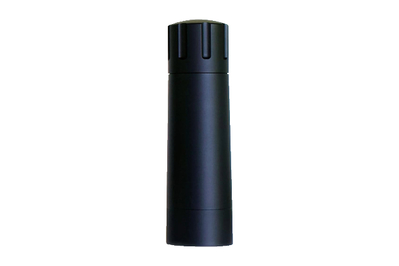
This metal pepper mill has the widest range of grind settings of any mill we’ve ever tested. But it’s pricey, and its all-metal construction is heavy.
It has an impressively wide range of grind settings. We detected over 60 grind settings, though the difference between one setting to the next is subtle. The Männkitchen Original Pepper Cannon is likely overkill for most home cooks, but if you take your pepper grinding seriously, it offers the widest range of grind settings of any mill we’ve tested.
Its knob spins smoothly. Most traditional hand-crank mills have some resistance as you turn the knob, but the Pepper Canon knob spins with almost no effort. The push button at the center of the knob releases it to gain access to the shaft, and its wide 1.75-inch opening makes filling convenient.
The metal cap contains pepper dust. However, the cap has a tight fit, and some of our testers had difficulty removing and reattaching it. Also, pepper dust still tends to collect in the gap between the crank knob and the body of the mill.
Flaws but not dealbreakers
It’s expensive and heavy. The biggest drawbacks are its high price and heft (it weighs over a pound), which was too cumbersome for most of our paid testers. However, Männkitchen also sells a smaller travel size that weighs 11.6 ounces and costs about $50 less.
It has a short warranty, especially for its high price. The Pepper Canon has only a five-year warranty, shorter than most of our other picks. But there’s no denying its superior all-metal construction. The burrs are made from high-carbon stainless steel, so they’re extra hard and sharp, and the body is made of aerospace-grade aluminum — it could certainly double as a self-defense weapon in a pinch.
Adjusting the grind settings could be easier. You adjust the grind settings using a knob on the bottom of the mill, and you’ll hear a satisfying click each time you turn it. However, we found it difficult to get a good handle on the knob, especially with greasy fingers.
Also, while the huge range of settings is impressive, this gradual differentiation could be annoying, say, if you wanted to switch between fine and coarse settings quickly.
Other pepper mills worth considering


If you want to add whimsy to your table: The Pepper Bird Grinder was designed in the 1950s but still brings a smile to our faces today. The beautifully sanded wood mill, which consists of mahogany, ash, maple, and walnut, makes a striking presence anywhere it’s perched. It may seem a bit impractical as your primary pepper grinder in the kitchen, but it was very popular among our paid testers, some of whom have grip strength and limited hand dexterity, since the bird’s unique shape allows for many different ways to hold it. The mill is elevated with feet, so you can also place it over a small ramekin and grind pepper directly into the dish. It would make a lovely addition to your dining table too — though keep in mind it doesn’t produce a super-fine grind. One tester said twisting the bird’s head to grind was “diabolical,” and others found it odd that the pepper falls from the bird’s rear end, but many found it amusing.
If you want an electric mill that can grind dried herbs and spices: The FinaMill Classic Battery can be used for spices other than peppercorns, but it has a coarser grind (regardless of the setting). We tested it by grinding coriander seeds, but it didn’t grind them as finely as pre-ground spices you’d buy in a jar. Unfortunately, most of our paid testers had difficulty opening the pods to fill them, which is one of the main drawbacks to this model — especially for those with low vision or hand-dexterity limitations. That said, it is easy to swap the pods on and off the body of the mill, and it grinds spices quickly. It requires three AA batteries, but FinaMill also sells a rechargeable battery operated mill with more pods for specific tasks. However, these various components can clutter up your drawers, so they may not be ideal for small kitchens.
If you need to grind a lot of pepper at once: A blade grinder, such as the Krups Electric Spice and Coffee Grinder, would be a good alternative solution to a traditional mill if you need to blend large amounts of pepper or other spices. It doesn’t grind as evenly, but it may be easier to use since you don’t have to disassemble it to refill, and you can still operate it using one hand.
How we picked and tested
Pepper mills are available in a number of styles: knob-twist, cranks, ratchets, or electric. However, their basic construction hasn’t changed much since they were first introduced by Peugeot (the same company that later made cars) in the mid-1800s.
The most common type of pepper mill has a knob at the top that attaches to a spindle, which spans the length of the shaft. Gravity guides the peppercorns down the shaft into a set of burrs (the grind mechanism) located at the base. The burrs, which look like a grooved cone set inside a grooved ring, are similar to the conical burrs of some coffee grinders.
Here’s what we looked for when choosing models to test:
Sharp and durable grind mechanisms: The best grinders have mechanisms made from ceramic, high-carbon steel, or case-hardened steel. They’re more expensive but worth the extra cost since they’ll likely provide you with decades of use. Ceramic mechanisms are harder than steel or even case-hardened steel, but longevity doesn’t seem to be an issue regardless of the style of mechanism — the bearings or bushings are more likely to wear out first. Salt doesn’t corrode ceramic grinders as it does with steel ones, and depending on the model, ceramic mills may also be used to grind dried herbs and some spices.
We’d avoid acrylic mechanisms, as the material could potentially flake off into your food.
Easily adjustable coarseness settings with a consistent grind: Some models allow you to adjust the coarseness of your pepper by twisting a dial to clearly marked settings. These are very precise and take the guesswork out of finding the desired coarseness setting.
However, these are less common, so we also tested the more common style of mill where you adjust the coarseness of your grind by twisting a screw at the top or bottom of the mill. Often these mills have a hard time keeping a consistent grind, because the movement required to turn the knob often loosens the screw, widening the space between the burrs. It can also be hard to gauge how much to turn the screw to get the exact-size grind you want. With that in mind, we looked for models with tight-fitting screws that held their positions well.
Easy-to-fill chambers: Most pepper mills have relatively narrow openings for filling the grinder, which can make refilling a pain (though we have tips for making this process easier).
Some models have pop-out chutes that allow you to fill the mill from the side without needing to unscrew the top. Other models can be filled from the bottom under a screwed-on lid. But after testing these styles, we think traditional mills that allow you to remove the head are the easiest to fill.
We also prefer mills with plastic or metal braces that secure the spindle in place because this makes filling the shaft easier. If the spindle is off-kilter while you’re filling the mill with peppercorns, the rod won’t align properly with the head.
A comfortable shape with decent capacity: We prefer mills 10 inches and under — if you go taller than that, your peppercorns will likely go stale as they wait to be ground. Super-tall pepper mills (like those you might see at a restaurant) make a dramatic show, but they’re precarious and too easy to accidentally knock off your counter.
We also took into account the diameter of each mill we considered for testing. If a pepper mill is too wide, it can be difficult to grip, especially if your hands are greasy.
Since not everyone can use a traditional hand-crank pepper mill, we also looked at electric models. But the experts we spoke with were lukewarm about them. The chief complaints: Most have slow output, are more prone to breaking, require batteries (up to six), and make considerably more noise during use.
That said, some people with hand-strength issues or chronic hand pain may find an electric push-button pepper mill easier to operate. Electric mills can also be used with one hand (though disassembling or replacing the batteries requires two hands, and often a healthy dose of patience).


A reasonable price: We tested pepper mills costing up to $200, but in most cases you’ll reach a point of diminishing returns, offering nothing better than models costing considerably less. The sweet spot is between $30 and $50. Beyond that, you’re likely paying for an interesting design or aesthetic.
A generous warranty: Most pepper mills offer very long or even lifetime warranties on the grinding mechanism. However, if you use your mill properly, longevity and breakage don’t seem to be big issues anyway.
We tested pepper mills by adjusting their coarseness settings to various positions to see how consistently and evenly they could grind. We also gave our wrists a workout by seeing how long it took each grinder to crank out a teaspoon of pepper and whether the grind was concentrated or sprayed.
Additionally, we checked to see the amount of peppercorns each model could hold. Using wet and oily hands, we gauged how difficult it would be to use the grinders in messy cooking situations.
For electric models, we took note of how noisy the motors were while grinding. Since pepper mills get equal play in the kitchen and on the table, we also took aesthetics into account. Ideally, we want pepper mills that aren’t an eyesore and that are nice enough to place on the table for a dinner party.
Care and maintenance
Many of the pepper mills we tested are designed to be used specifically with black peppercorns. Colored peppercorns (which include red, pink, green, and white peppercorns) can gum up the grinder because they have been treated and/or may have a higher moisture content than black ones. If you’re using colored peppercorns, be sure to mix them with black peppercorns to keep the mill running smoothly. It’s always best to check the manufacturer’s instructions if you’re unsure.
Don’t use a mill with steel burrs to grind salt, dried herbs, or other spices, all of which can corrode the metal. You can use a mill with ceramic burrs to grind these things, but it’s a bit impractical to grind them anyway. Salt tastes the same whether it’s factory-crushed or mill-ground. And for other spices, you have to clean the mill every time you switch from one to the next.
If the exterior of your mill becomes gunky, wipe it down with a damp cloth (see our other tips on how to clean a pepper mill).


If you’re having trouble getting peppercorns into your mill, use a piece of folded paper as a funnel. You can easily tuck the piece of paper away in a cupboard so it’s always on hand. This makes it a cinch to neatly direct squirrelly peppercorns into a pepper mill.
The competition
This is not a comprehensive list of everything we tested in previous iterations of this guide, just what’s still available.
Manual pepper mills
The Cole & Mason Forest Capstan Pepper Mill lacks a plastic guard to keep the center spindle in place. When it was filled, the peppercorns pushed the spindle out of position and made attaching the top of the pepper mill impossible.
The Cole & Mason Derwent Pepper Mill ground pepper unevenly. Its output was also a little slower than many of our picks.
The Cole & Mason London Grind Select Pepper Mill has a dial at the base for adjusting the coarseness setting, but it wasn’t as seamless as the Peugeot Paris u’Select model we recommend. Sometimes the dial would jump to the next setting while being adjusted. For roughly the same price, the Paris u’Select performed better.
The Stockholm Pepper Mill was easy to fill, but we couldn’t discern much difference in the grind size regardless of the setting.
The vibrant-green-lacquered Addison Ross Twister Salt and Pepper Mill has a striking design, but its wide diameter and distinct grooves made it awkward to hold and operate. It also lacks a brace for keeping the spindle in place, making it harder to fill.
The HexMill Pepper Grinder is very similar to the Männkitchen Original Pepper Cannon we recommend, but it weighs over 1.5 pounds and was far too heavy for many of our testers to hold.
The Hem Molino Grinder would be eye-catching in a restaurant, but we found it comically large for home use. The large horizontal handle was also awkward to spin.
The Sur la Table Ratchet Mill is similar to the Kuhn Rikon Adjustable Ratchet Grinder, but we found the handle more jerky to operate — it felt as though the peppercorns were jamming the grind mechanism, requiring more effort to use than most traditional twist-knob-style mills.
We had difficulty adjusting the grind settings on the Zassenhaus Berlin Pepper Grinder. The plastic twist knob used to adjust the grind settings was easily clogged with pepper dust and made grinding inconsistent.
The Zassenhaus Speyer Pepper Mill sprays pepper everywhere, and we found it difficult to turn the handle. Its small shaft opening made filling a hassle.
The IKEA Ihärdig Spice Mill struggles to transition from coarse back to fine, and the grind isn’t very even.
The Olde Thompson Senator pepper mill has a classic look at a great price. But when we loosened the nut at the top for coarser grinds, the top felt like it might fall off the body. This model was also a challenge to use with slippery hands due to its thinner, difficult-to-grasp top knob.
The OXO Good Grips Radial Pepper Grinder has a plastic housing that doesn’t feel very durable. We also had trouble turning the top handle with greasy hands, and the crank action sprayed pepper over a too-wide area.
The OXO Good Grips Pepper Grinder grinds pepper that is about the same coarseness regardless of the setting. During our tests, some pepper dust got caught in the threading of the opening and jammed it shut (the only way to open it was with a pair of needle-nose pliers).
The Atlas Brass Pepper Mill was the other model that had metal shavings show up in the initial grind (we chalked this up to getting another manufacturer lemon). Shards aside, this mill’s refill system is a bit fussy.
The Chef Specialties 10-Inch Imperial Walnut Pepper Mill uses a stainless steel grind mechanism (versus high-carbon steel), and it ground pepper inconsistently.
The William Bounds Key Mill is quite small, at 4 inches, and it comes with only three coarseness settings. Also, its clear body exposes peppercorns to the light.
The PepperMate Traditional Pepper Mill 723 has a ceramic grinder, but the mill’s body is made of plastic and isn’t very durable. We also didn’t think it was nice enough for table use.
Electric pepper mills
The Williams Sonoma Rechargeable Pepper Mill takes over a minute to grind 1 teaspoon of pepper. However, we like that this model is rechargeable.
The Trudeau One Hand Battery Operated Peppermill has a cheap plastic housing and took 3 minutes to grind a teaspoon of pepper.
The Trudeau Graviti Plus has five grinding positions, but each produces coarsely ground pepper — this mill isn’t capable of producing a fine grind.
The Cole & Mason Hampstead Precision Electric Pepper Mill was easy to disassemble, but it took 1 minute to grind a teaspoon of pepper and couldn’t achieve a very fine grind.
The Zassenhaus Gera Electric Pepper Mill was the slowest electric model we tested — it took over 3 minutes to grind a teaspoon of pepper.
The Ozeri Graviti Pro Electric Pepper Mill and Grinder grinds automatically when inverted, a feature we disliked on the Trudeau Graviti Plus.
This article was edited by Gabriella Gershenson and Marilyn Ong. Ganda Suthivarakom and Jennifer Fields contributed to previous versions of this guide.
An earlier version of this article incorrectly described how long the Peugeot Paris u'Select Pepper Mill has been a pick. It has been a pick since 2014, not 2015.
Sources
William M. Carty, PhD, former emeritus professor of ceramic engineering and materials science at the Inamori School of Engineering at Alfred University, phone interview, May 22, 2025
Diane Morgan, James Beard–award-winning cookbook author, phone interview, January 7, 2014
Jennifer Jasinski, James Beard–award-winning chef, email interview, 2014
Stephanie Coyle, former culinary director for Sur La Table, email interview, 2014
Patty Erd, former spice merchant and co-owner of The Spice House, interview, 2014

Advertisement
SKIP ADVERTISEMENT
Comments are disabled for this review
You can also contact us or send us a tweet, or find us on Facebook.