


Ellen Airhart wrote about emergency preparedness and sanitation. She's used blood and dog excrement to test cleaning products.
In 2016, a Bounty paper towel life-cycle analysis stated that at least one of the Canadian trees pulped to make them was 68 years old. That means that the towel you might use to wipe crumbs off your kitchen countertops could be the limb of a tree that sheltered chipmunks, survived forest fires, and aerated the soil since the Truman administration. And there it goes, into the trash can.
The most straightforwardly environmentally responsible reaction to this fact is to use fewer paper towels. But messes are inevitable, and a strict austerity puts the moral injury on the person doing the hard work of cleaning. While paper towels are a difficult habit to break, Swedish dishcloths are less expensive and more sustainable—if you use them long enough.
Top pick
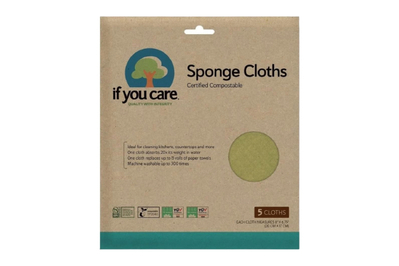
Of the seven Swedish dishcloths we tested, this cloth tied as the most absorbent, and only one other option was cheaper.
If you’re facing a quickly spreading puddle, the If You Care Sponge Cloth is the hero you need. A single 54-square-inch cloth can absorb as much as 36 tablespoons of water, about the volume of a standard can of tomato soup. It’s also inexpensive, at $1.15 per cloth at this writing. Only one other Swedish dishcloth we tested, the Wettex Original, was cheaper at $1.00 a pop, but it absorbed half the amount of water that the If You Care cloth did. If You Care carries its commitment to sustainability through to the packaging as well, which is cardboard instead of single-use plastic.
The research
Why you should trust us
We spent three days testing Swedish dishcloths. We doused seven of them in ketchup in order to evaluate their stain resistance. (Spoiler: All of the cloths we tested emerged from this test spotless, once we washed the ketchup off.) We poured water on them, tablespoon by tablespoon, to test absorbency. And we washed them repeatedly to confirm that they could withstand the wear and tear.
We read two life-cycle analyses of paper towels and several Swedish dishcloth patents in order to understand the material we were looking at. We also spoke to Seung-Jin Lee, assistant professor of mechanical engineering at the University of Washington Tacoma, about a Bounty paper towel report that he helped write, and we spoke to Jenna Davis, director of brand marketing for If You Care.
Who this is for
There is no perfect paper towel replacement. Every contender has to last a certain number of cleaning sessions before it’s less resource intensive than a paper towel. That number differs based on the product, and how you define “sustainable.” For example, in the 2016 Bounty life-cycle analysis mentioned above, the researchers found that the most detrimental environmental effect of the creation of the paper towels was the fossil-fuel depletion necessary for the processing of the paper.
The manufacturing of Swedish dishcloths also requires energy, although the cloths are more durable. Traditionally, they’re made of a combination of cellulose—the cell wall of plants, including trees—and cotton, according to Jenna Davis, director of brand marketing for If You Care. They’re about half the size of a paper towel sheet, and they initially feel soft and squishy, like a sponge. Once washed, they stiffen up a bit but remain flexible. Each one is about as thick as a loose stack of six paper towels and has ridged patterns embedded in the material for scrubbing power. This kind of cloth was invented by Swedish engineer Curt Lindquist in 1949, which is how they came to be known as Swedish dishcloths, according to Wettex.
As of now, we don’t know how many times you have to use a Swedish dishcloth before it’s more sustainable than a roll of paper towels, because we haven’t seen a publicly available life-cycle assessment for these cloths as we have for paper towels. And according to Lee, it’s impossible to fully quantify the true environmental impact of a supply chain for either paper towels or Swedish dishcloths. But many brands estimate that each dishcloth can replace 15 rolls of paper towels, according to The Guardian. Davis told us that the number could be as high as 18 rolls if the If You Care cloths are cared for properly, and claimed that the cloths can withstand about 300 washes.
Swedish dishcloths have a few downsides. After one use, their texture is forever altered: Even if you dry them on a flat surface, they transform from soft and bouncy to flat and hard, similar to how a sponge flattens and stiffens with use. Swedish dishcloths also take longer to dry than microfiber cloths, another paper towel alternative we like; we found that the cloths we tested, across brands, were still slightly damp in the middle after six hours of drying time. Below you can read more about how Swedish dishcloths compare to microfiber cloths.
How we picked and tested


We started by scouring the first page of Amazon search results, as well as roundups from Serious Eats and The Strategist. We didn’t order options that had low or suspicious ratings (as determined by Fakespot). We also bypassed cloths that cost more than $4 each.
We measured the amount of water each towel could soak up. First, to make the contest fair, we cut down the edges of each cloth to make them roughly the same size. Then, we dropped tablespoons of liquid on each contender to see which brand’s cloth could take in the most water. We found that the most successful Swedish dishcloth held 36 tablespoons of water, whereas one Bounty paper towel sheet soaked up less than 3 tablespoons.
We marinated the cloths in ketchup. Stains age dishcloths quickly and make them look ugly on your kitchen counter. To evaluate whether the cloths would return to their original color after cleaning up a mess, we put all the cloths in a big metal bowl and sprayed them with ketchup. We rubbed in the ketchup as if we were marinating a piece of meat, and then we let the cloths sit for several hours. We then ran the cloths through a washing machine to see whether the stains would come out. All the cloths we tested came out looking squeaky-clean.
We washed them over and over again. If You Care’s Jenna Davis said that the company’s dishcloths should be able to withstand more than 300 washes. Although we didn’t put our cloths through the washing machine hundreds of times, we wanted to check their immediate durability, running them through the washing machine on high heat four times and checking for any fraying or thin spots in the fabric.
We looked at the environmental certifications. Many of the brands we tested operate in Europe as well as the US, so we checked standards and certifications from both continents.
Top pick: If You Care Sponge Cloths


Top pick
Of the seven Swedish dishcloths we tested, this cloth tied as the most absorbent, and only one other option was cheaper.
If You Care’s Sponge Cloths were the most absorbent cloths we tested, soaking up 36 tablespoons of water, tying with the Skoy Cloth for the most water absorbed. But while the Skoy dishcloths cost $2 each, the If You Care cloths cost $1.20 each—cheaper than most of the others we tested for this guide. For comparison, two rolls of Bounty paper towels cost about $5 at this writing, and since Swedish dishcloths can replace about 15 paper towel rolls each, that’s more than $40 saved per dishcloth.
Their packaging is sustainable. Davis told us that If You Care’s packaging used to be made of bioplastics, but once the company realized that no one was recycling this material, it switched over to a thin cardboard that can be composted or recycled with paper products. All inks and dyes that the company uses are vegetable-based.


They are compostable. These dishcloths are certified commercially compostable by the North American standards organization BPI, as well as by European Bioplastics. They’re certified home compostable by the accreditation company TÜV Austria. To pass the testing, these cloths had to break down in both a garden and a municipal compost pile, according to Davis. Of course, to take advantage of this environmental benefit in the United States, you must have access to a commercial composting program that accommodates Swedish dishcloths.
Flaws but not dealbreakers
They have a funky texture after drying. After you get them wet, they become stiff and dry in the shape of whatever they’re sitting on. If you hang them on cabinet handles to dry, for example, they don’t rest flat afterward, which makes them difficult to store and stack.


They can’t replace paper towels entirely. Sometimes, a mess is gross enough that you need to throw away anything that has touched it (think biohazards, such as raw meat, eggs, or vomit).
What about microfiber cloths?
Microfiber cloths are made from plastic, which ultimately means that they’re derived from fossil fuels. They’re a viable paper towel replacement, and they’re less expensive than Swedish dishcloths, but they have some environmental disadvantages.
They’re cheaper. Our microfiber cloth pick comes in at around 60¢ per cloth. One If You Care cloth is double that price.
Microfiber can catch microbes. Researchers have demonstrated that microfiber cloths are significantly more effective at removing disease-causing bacteria than cotton cloths, partly because of their static attraction and partly because the edges of the tiny fibers act “like a carpenter’s plane, peeling off deposits,” according to another study. One research group tested microfiber cloths from different brands and found that all nine reusable cloths performed similarly well at removing microbes, no matter their price. Just be sure to wash yours afterward.
They last about the same amount of time. Both microfiber cloth manufacturers and the company behind our Swedish dishcloth pick estimate that their cloths last about 300 washes. A healthcare hygiene study out of the UK found that the performance of the microfiber cloths the researchers tested actually improved over time, up to a point: “After repeated washing, re-usable cloth performance improved at 75 washes, and reduced after 150 washes, although, in most instances, performance after 150 washes was better than at first wash.”
Microfiber absorbs less water. Microfiber cloths are slightly less absorbent than Swedish dishcloths: Our microfiber cloth pick absorbed 31 tablespoons of water, in contrast to the If You Care dishcloth’s 36 tablespoons. They also dry much more quickly—in our experience, microfiber cloths took two hours to dry, while the Swedish dishcloths were still damp after six hours.
Microfiber sheds microplastics. “No bones about it—microfiber cloths are made from plastic, and they definitely shed microplastics,” said Katie Okamoto, Wirecutter’s editor of sustainability coverage. Our Swedish dishcloth pick does not contain plastics, micro or otherwise. If You Care uses the substance mirabilite for absorbency, according to Davis. Mirabilite is a crystal that forms naturally in saline lakes.
The competition
In our tests, the Skoy Cloth tied the top-pick If You Care cloths in water absorbency with 36 tablespoons, but they cost more per cloth. The Wettex Original and Scotch-Brite Reusable Wipes all absorbed less than 30 tablespoons of water, knocking them out of contention.
Superscandi’s Swedish Dishcloths, Swedish Wholesale’s Swedish Dishcloths, and The EcoGurus’s Swedish Dishcloths performed well in our tests, with water capacities of 33, 30, and 33 tablespoons, respectively, and they cost about $1.50, $1.60, and $1.80 each. But our top pick absorbs slightly more and costs a bit less.
Papaya’s Reusable Paper Towels are cute and come with a specialized hanging hook, but these Swedish dishcloths aren’t worth $8.25 a pop. They absorbed only 22 tablespoons of water in our tests.
We ordered the Who Gives a Crap Dream Cloths, but they never arrived. We reached out to the company, and the representative said the dishcloths were lost in transit.
This article was edited by Jen Gushue and Harry Sawyers.

Further reading
The Best Microfiber Cleaning Cloths
by Caroline Mullen and Ellen Airhart
Most microfiber cloths are essentially the same, but after weeks of testing, our cleaning writer liked the Kirkland Signature Ultra Plush Microfiber Towel best.
How to Use a Microfiber Cloth to Clean (Almost) Every Device in Your Life
by Kimber Streams
The humble microfiber cloth is one of the most essential and underrated cleaning supplies in anyone’s toolkit.
I’m Wirecutter’s Laundry Expert, and My Favorite Cleaning Cloth Is a Diaper
by Andrea Barnes
Believe it or not, reusable cloth diapers are fantastic for a multitude of home cleaning tasks.Workout Clothes Stink. Here’s How to Clean Them.
by Ingrid Skjong and Gabriella DePinho
Performance fabrics can present unique laundry challenges. Follow these tips to keep your workout clothes fresh, clean, and in good shape for the long haul.


Advertisement
SKIP ADVERTISEMENT