


Andrea Barnes is a writer covering large cleaning appliances. Each year for testing, she runs over 120 dish cycles and washes 120 loads of laundry.
One day when my daughter was 3, I noticed a hot-pink stain on my living room ceiling. It was the remnants of a sticky slap hand — a gooey, foot-long toy meant to be thrown at walls — taunting me.
Atop a ladder, craning my neck, I attempted to clean the ceiling with a damp washcloth, dish soap, surface spray, and even white vinegar. Finally, in a harebrained, last-ditch attempt, I grabbed a bottle of Dawn Powerwash dish spray. I spritzed the pink stain and wiped it down with a barely damp paper towel.
The stain vanished. Dawn Powerwash accomplished in seconds what I couldn’t do in hours! This was the moment I joined the masses of Dawn Powerwash believers. (There are many.)
Years later, I put the trusty spray bottle through the paces of our dish soap testing, and its superior performance cemented it as an official pick. As a dish spray, it’s a potent grease-buster. But I’ve also continued to discover more off-label uses both in my own life and from other Dawn Powerwash enthusiasts among Wirecutter’s staff.
Of course, you can’t do everything with Dawn Powerwash, but you can do a whole freaking lot.
Top pick
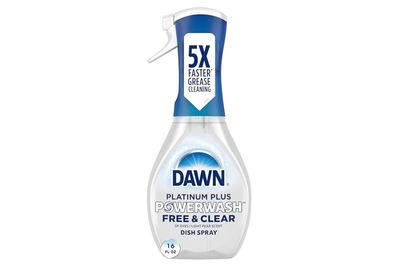
This clear dish spray busts through grease and grime quickly and effectively. It’s potent, though, and one spritz is usually all you need.
Dawn Platinum Plus Powerwash Free & Clear is like dish soap on steroids. Regular dish soap leans primarily on surfactants (oil-pulling, soap-like molecules) to cut through grease. Dawn Powerwash, in contrast, contains both surfactants and solvents — cleaning agents that literally dissolve grease and other soils, which minimize how long you need to soak or scrub a dirty pan. Solvents are wildly efficient for cleaning (consider how well acetone works on nail polish, for example), and Dawn Powerwash contains powerful solvents but is safe for use on everyday items.
No matter the cleaning project, you can use Dawn Powerwash in pretty much the same way:
Spray the mess: Spritz Dawn Powerwash directly onto whatever surface you’re cleaning. Start with one or two sprays — you can always add more later.


Watch the suds: At first, you’ll see a thick, tight band of foamy suds. As the cleaner gets to work, the suds dissipate. After a few minutes, once that foam has diminished (it almost looks like it has changed color), you can get to cleaning.


Wipe or rinse (and maybe repeat): Use a damp cloth (not too wet, to avoid activating more suds) or a running faucet (or hose) to wash away the gunk. Some tough cleaning projects might require multiple spray-and-waits.
Here’s how we use Dawn Powerwash at Wirecutter, plus a few ways we don’t.
Greasy pots and pans (of course)
Let’s start with the obvious: Even if you have a dishwasher, some messes are simply too stubborn to skip a sink soak. During testing at our Long Island City, New York, offices, Dawn Powerwash cut through baked-on grease, oil, and starch after just a minute or two of sitting. In my own home, where the messes aren’t intentionally extreme, it works even faster.
You simply spray it onto the gunky pan and let it sit. When the bubbles dissipate, they’ve finished their job of removing grease and grime, and you’re good to rinse your pan off.


But don’t use it on seasoned pans.
Though it’s okay to use regular dish soap on cast iron and other seasoned pans, be wary of using Dawn Powerwash on these pieces. Its grease-dissolving formulation could potentially remove seasoning.
And don’t use it on dishes that will be going in the dishwasher.
While it might seem like a great idea to give crusty dishes and pans a cleaning boost before putting them through a run in your dishwasher, the surfactants in Dawn Powerwash, much like those in dish soap, are not formulated for dishwashers and could leave a sudsy mess in the bottom of your machine. (Way too much could even overflow onto your kitchen floor.)
All over the kitchen
Naturally, Dawn Powerwash is also good for other kitchen-cleaning tasks, especially those that are otherwise tough to tackle.
Gunky kitchen knives: If you’ve chosen to invest in a good chef’s knife, you likely know not to put that puppy in the dishwasher. But if you don’t rinse it right away, gunk from tomatoes, onions, or steak can be hard (and possibly a little dangerous) to scrub off the blade. To get around this, Wirecutter photographer Michael Murtaugh sprays the blade of his chef’s knife with Dawn Powerwash, lets it sit a few minutes, and then easily wipes it clean.


Filthy sinks: After using Dawn Powerwash during testing cleanup for our portable dishwasher guide, Wirecutter writer Evan Dent was a quick Powerwash convert. He now sprays down his stainless steel kitchen sink with Powerwash weekly. He says it has all but eliminated the usual tedious scrubbing, and the sink “wipes down sparkling clean!”
Cruddy cooktops and range hoods: The grease-dissolving mechanism of Dawn Powerwash makes it especially effective on both glass cooktops and traditional stoves, whether they’re gas or electric, as I heard from quite a few of the Wirecutter staffers I polled. On my own glass induction cooktop, a few sprays with Dawn Powerwash break down hard-to-clean residue, making it easier to scrape off with a razor.
You can also spray greasy range hoods with Dawn Powerwash and clean them as you normally would.
Dingy appliances: Stains such as hard-water spots on stainless steel appliances often contain calcium and other metals that can be difficult to clean. Dawn Powerwash contains ingredients that help pull out these kinds of spots, says Morgan Eberhard, a senior communications scientist for Dawn. This makes Powerwash ideal for restoring shine to stainless steel dishwashers, refrigerators, and oven doors. (Its grease-busting properties also work well on fingerprints — it’s a win-win.)
Powerwash’s abilities aren’t limited to large kitchen appliances or stainless steel, either. Wirecutter writer Liam McCabe recently used it to clean his nine-year-old Coway air purifier’s filter. His only complaint: He wishes he had thought of it sooner.
But don’t use it on wood.
Dawn Powerwash can damage certain types of wood, so avoid spraying it on or near things like wooden knife handles or butcher-block counters.
And don’t use it on electronic components.
I would hope this one is obvious, but don’t spray any electrical components of your appliances with Powerwash.
Weird clothing stains
Regular dish soap and a good laundry detergent are all you need to tackle many types of oily and biological stains, such as cooking-grease splatters or blood. But stains from synthetic products like glue, paint, or ink usually require a stronger stain remover, such as a solvent.


Because Dawn Powerwash contains solvents, it works like a charm on many of these types of unusual stains, including kids slime, squishy-toy residue (or innards), lip gloss, mascara, and school glue. It once saved the day by successfully removing paint from one of my daughter’s favorite rompers — even after the paint streaks had gone through a wash-and-dry cycle.
In fact, its combination of sophisticated surfactants and solvents can tackle some ink and paint stains that even our top-pick stain remover, Amodex, struggles with at times. (Overall, though, Amodex, a soap-based stain remover that you use to massage out ink, rather than dissolve it, does a better job on most of these types of clothing stains.)
But limit a pretreatment to one spray.
Ideally, you should spot-clean and rinse a stain, but sometimes stains need a full wash cycle for complete removal. If you use Dawn Powerwash as a pretreatment, apply only one spray’s worth — otherwise you risk an overflow of suds in your washing machine.
Stubborn sticky stuff
Dawn Powerwash’s glue-busting superpowers aren’t limited to textiles, either. The unique dissolving properties of Powerwash are what eliminated the hot-pink stain on my ceiling years ago. It’ll also make quick work of sticker residue from price tags, your kid’s overzealous decorating project, and everything in between.
But avoid wood furniture
Again, Powerwash and wood don’t always play well together. So use a gentler cleaning method to clean a craft project’s remnants from your dining table.
Typically tricky tiles (and the whole shower)
Writer Alexander Aciman is a huge fan of Dawn Powerwash, but his favorite use is for cleaning dirt and soap scum from tile and grout. “It works better than anything else I have tried,” Alex told me. I agree — the sealed, pebble tile in my shower is nearly impossible to clean, but a spray of Powerwash allows me to cut my scrubbing time in half.
I haven’t tested this method on mold or mildew, so I am unsure of how well it would work in that regard, but when it comes to typical shower crud, Powerwash is terrific. Wirecutter podcast producer Abigail Keel says it’s great at tackling the scum on her shower door, too.
But don’t use too much.
Be sure to limit your sprays on this sort of project. Otherwise it will be hard to rinse off and could leave a dangerously slick, slippery floor.
And don’t use it on porous surfaces.
I can clean the river-stone tile in my bathroom with Dawn Powerwash because it is sealed. If you’re unsure whether the marble, granite, or other stone in your bathroom (or on your kitchen counter, for that matter) is sealed, don’t risk using Powerwash on it.
Outdoor equipment
A working hose and Dawn Powerwash make an unstoppable power couple. Armed with both, you can tackle a number of projects.
Grubby outdoor toys and other plastic stuff: Summer rainstorms tend to leave all manner of dirt and debris on my daughter’s favorite toy taco truck. After shaking off any dirt and leaves, I spray down her toy truck with Powerwash, wait for the suds to dissipate, and hose off the residue. I use this same cleaning method on trash cans and plastic furniture.


Greasy grill grates: This is another popular outdoor use in my household. (Even better if you use this tool with it.) As with other Powerwash cleaning projects, remove your grill grates, place them on a waterproof surface, and spray them down with Powerwash.
Grimy hubcaps: Wirecutter editor Rory Evans gave cleaning her hubcaps a shot and said Powerwash worked like a marvel — so much so that her husband wanted to clean more things with it.


But do this only on pavement and near drains.
To avoid getting soapy water into the ground, be sure to do any projects like this on pavement and where the water will reach a sewer. And as always, be mindful of how much you spray, as the more Powerwash you apply, the more suds you’ll have to rinse.
One last thing
Ignore the influencers who say that you can DIY a Powerwash-like mixture by putting a solution of rubbing alcohol, Dawn dish soap, and water into an empty Powerwash bottle. Powerwash’s particular blend of surfactants and solvents is not simply dish soap and alcohol, and the spray bottle is only one component of its cleaning strength. (And in general, no one should be in the habit of mixing cleaning products, lest they accidentally create toxic fumes.)
We tested the DIY version against the real thing, and the DIY option was not the worst surface cleaner, but it wasn’t Powerwash. In fact, I’m not sure it was much different than using a few drops of dish soap in a spray bottle of water (which is also one of my favorite cleaners). On top of that, the homemade version smells far worse, due to the rubbing alcohol.
So the next time you’re confronted with a seemingly unwinnable mess, maybe spray some Dawn Powerwash on it? And if you have an off-script Powerwash use you love, let us know.
This article was edited by Catherine Kast and Marguerite Preston.
Meet your guide

Andrea Barnes
I research and report on dishwashers, washing machines, dryers, and laundry. This involves touring factories, visiting showrooms, attending trade shows, speaking with appliance-brand representatives, interviewing experts, studying patents and schematics, and reading manuals. I am based in New York City, and I test appliances in our Long Island City office.
Advertisement
SKIP ADVERTISEMENT