


Marguerite Preston spent eight years editing Wirecutter's kitchen coverage and drank a lot of coffee in the process.
Of all the ways to make coffee, the espresso machine is the most intimidating. Most other brewing methods require you to do little more than measure out some coffee and pour water over it. Making espresso drinks brings in a slew of other variables: monitoring water pressure, tamping coffee grounds, steaming milk.
But in the eight years I spent editing Wirecutter’s kitchen coverage, I tried just about every piece of coffee gear we cover. And of the five different coffee brewing devices I personally own (I swear, I use all of them), the Breville Barista Touch wins out as the speediest and (somewhat surprisingly) easiest to use. It’s been a lifeline on many frantic school mornings (second only to my beloved fancy instant coffee) and a delightful source of needed pep when the afternoon doldrums hit.
Runner-up
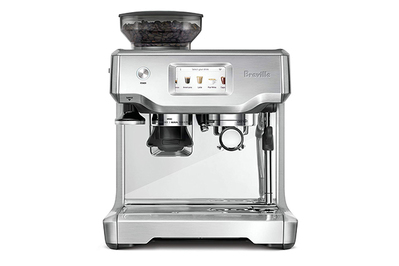
Sleek and powerful, with great programming and a solid built-in grinder, the Barista Touch lets beginners make a variety of café-quality espresso drinks at home with very little learning curve.
Upgrade pick

The Breville Oracle Jet grinds, doses, tamps, and froths your milk for you, and it guides you through the entire espresso-making process.
Breville makes a wide range of espresso machines. We haven’t tested them all, but the ones we have tried for our guide to the best espresso machines handle the basics well. They heat up especially fast, and they maintain a steady temperature and pressure, making it easier to consistently pull a good shot than most entry-level home espresso machines we’ve tested.
But we specifically recommend the Breville Barista Touch and the Breville Oracle Jet Espresso as the two machines in the lineup that will serve you well whether you want to mindlessly make a decent cappuccino every morning or launch into a full-blown espresso hobby.
Masterful steamed milk
We’ve tried other machines with automatic steam wands, but the steamed milk they produced was overly frothy and underwhelming. In comparison, milk steamed with the automatic wand on either of our Breville picks is basically indistinguishable from what you might get at a café. A rich, silky layer of microfoam covers the surface, and the temperature is just right. You can even adjust the amount of foam and the temperature of the milk to your liking.
It’s so fast and convenient, you may find yourself steaming milk for all kinds of other things too. I like to use the steam wand on my Barista Touch for matcha lattes and London fogs. Justin Vassallo, one of the authors of the espresso machine guide, found it perfect for making cooler, “toddler-friendly” hot chocolate for his daughter.
The wand also automatically purges itself with hot water when you’re done steaming, an especially handy feature that helps you avoid any unfortunate clogs or gunky situations.
You can use the wand for manual steaming too, if that’s a skill you want to practice.
An all-in-one option


Beyond the automatic milk frothing, the Barista Touch and the Oracle Jet offer more of a helping hand than the average espresso machine on a couple of other fronts.
For one thing, the built-in grinder saves you from having to buy one separately, and it also keeps the whole grinding and brewing process compact and efficient. The Oracle Jet also automatically doses and tamps your coffee, cutting down on both mess and inconsistencies.
The touchscreen controls, which could have been nightmarishly convoluted considering how many settings this thing has, are actually delightfully straightforward to use. You can swipe through a menu of preprogrammed drink settings or program your own, adjusting the grind duration, the shot duration, and the temperature and froth level of your steamed milk. The Oracle Jet will even suggest grind adjustments if it detects that your shots are pulling too fast or too slow. You can also just manually start and stop any of the functions with a single poke of the screen.
All of that may sound like a lot to manage and tinker with. And it kind of is, but if you’re looking to hone your espresso skills, it might be a good thing. In that case, it’s nice to have all those numbers—the grind size, the timers for grinding and brewing, the milk temperature—clearly displayed on a single screen, where you can easily adjust them.
But you can also just lean on one or two settings. I’ve found the parameters that work for the espresso I usually brew, and I have them saved in a program that allows me to brew pretty mindlessly: I just press one button to grind, tamp the coffee down, lock in the portafilter, and press another button to brew.
The learning curve
Breville’s espresso machines are certainly not as simple to use as a Nespresso machine, and you’ll at least need to read the manual and do some initial tinkering to find the settings that produce a shot you’re happy with. You may also occasionally need to adjust them, if you switch coffee beans, say, or if your shots just start pulling funny.
Those with the loftiest espresso ambitions may find some aspects of the Breville machines limiting. For example, the Touch’s portafilter is a bit smaller than standard, and narrower and deeper. We found that the double-filter basket barely fits 15 grams of coffee, which is on the small side for a double shot. And the depth means water has to push through a thicker bed of coffee, introducing more variability into each pull. Also, finding compatible accessories, should you want to geek out on things like tampers and filter baskets, can be tricky. (The Oracle Jet uses a larger, more standard portafilter).
And neither machine has a pressure gauge. They’re so consistent, you don’t really need one, but it’s the kind of thing you might want to have if you’re ready to obsess over all the details.
But truthfully, the espresso rabbit hole is very deep and very expensive, and one that I think plenty of people are perfectly happy never to go down. With Breville’s machines, you can probably make an espresso drink you’re happy with, and have fun honing your skills if you wish, while owning an appliance that even a houseguest could figure out how to use.
Care and maintenance
Be prepared for the fact that making espresso can be messy, and your machine will require some maintenance.
There’s no neat way to fill a portafilter, and when using the Barista Touch, some coffee grounds will inevitably go everywhere. To help catch the overflow, I stick a shallow bowl under the portafilter when I’m grinding coffee, and I keep a kitchen towel next to the machine for wiping off my hands and surfaces. (This is not an issue with the Oracle Jet, which keeps all the grounds contained within its tamping mechanism.)
You’ll also need to wipe splatters from the drip tray and backsplash, run hot water through the portafilter, and wash out the drip tray regularly (it can get slimy fast). The auto-purge feature will do the bulk of cleaning the steam wand after you use it, but you should still wipe the wand down with a clean, damp cloth or sponge.
Like any coffee brewer, espresso machines also need to be descaled regularly to keep everything flowing smoothly. Conveniently, both Breville machines will remind you to do it and have a dedicated descaling program.
Don’t neglect the grinder, either. You can clean the built-in one in the same way you’d clean a standalone grinder, and it will keep your coffee tasting fresh and your grind consistent, while preventing jams.
Breville covers its machines with a two-year warranty and sells a variety of replacement parts. If you’re handy, you may be able to perform some basic repairs yourself. Senior staff writer Kit Dillon says that he was able to repair some worn-out boiler hoses and some electrical contacts that had been corroded by steam on his decade-old Breville espresso machine.
This article was edited by Alexander Aciman, Annemarie Conte, and Marilyn Ong.

Further reading
The Best Electric Kettle
by Anna Shults Held, Sarah Zorn, and Michael Sullivan
Through multiple rounds of testing since 2013, the Cuisinart CPK-17 has remained our favorite electric kettle. It’s fast, accurate, and easy to use — all at a great price.
The Best Home Espresso Machine
by Justin Vassallo and Ciara Murray Jordan
After making (and tasting) dozens of espressos and lattes, we think the Profitec Go is the best machine for both new and skilled espresso enthusiasts.
The Gadgets We Bring on Every Trip
by Ivy Liscomb
You don't have to be a digital nomad to travel like one. Here are a few gadgets and accessories to make travel as painless as possible.I’m Wirecutter’s Travel Editor. Here’s What I Bring to Every Vacation Rental.
by Christine Ryan
Wirecutter’s travel editor shares the six little essentials she brings to every vacation rental to feel more at home. And they’re all under $50.


