


By Laura Motley
Dehydrating food is an ancient art. For millennia, people dried everything from meat to vegetables to fruit, relying on just sun, wind, and simple structures. You can still preserve foods using those age-old methods, but a modern-day electric food dehydrator makes the process a whole lot easier.
Good versions, equipped with powerful, not-too-loud fans, can transform raw ingredients into delicious, shelf-stable provisions. Though fruit leather and beef jerky are food-dehydrator classics, these machines can prepare all kinds of things — think homemade dog treats and dried citrus wheels for holiday decorations.
We’ve tested 17 popular models over the years, and we’ve found that the sleek, powerfully effective Magic Mill Food Dehydrator MFD-7070 is the best option for most home cooks. But if you want to tackle especially large-scale projects, we recommend the more-spacious Magic Mill Premium Food Dehydrator (10 trays).
Everything we recommend
Top pick
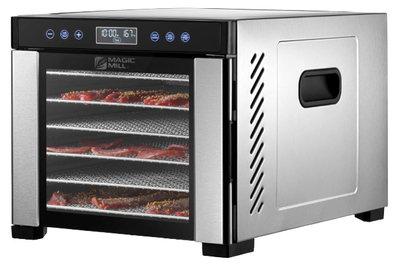
This stainless steel dehydrator has a sleek look and a pleasantly quiet fan. Its generous amount of drying space makes it well suited for most at-home projects.
Budget pick
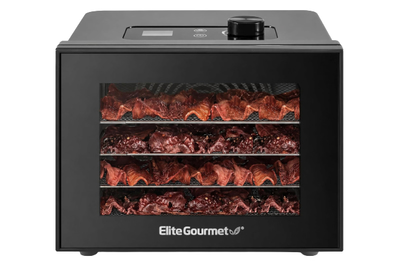
This tiny appliance performed better than the other under-$75 dehydrators we tested, and it can fit in even the most cramped spaces. But it’s not suitable for large-scale projects.
Best for...
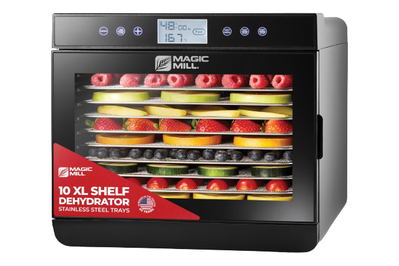
With tightly racked trays that offer nearly 11 square feet of drying space, this big yet streamlined dehydrator delivers excellent bang for the buck. Its black plastic exterior is less attractive than our top pick’s stainless steel, though.
What we dehydrated
- 20 pounds of apple chips
If a machine yielded chips that came out browned and brittle or sad and soggy, that indicated uneven heating or poor airflow.
- 30 bunches of mint
Dried herbs are small and delicate. On this test we appreciated models with fine-mesh metal trays.
- 10 pounds of fruit leather
Fruit leather, a popular dehydrated food, needs to be evenly spread on a flat surface. Smooth plastic trays made this task easiest.
- 10 pounds of beef jerky
Beef jerky, dripping with rendered fat, made a mess during testing. This test helped us identify difficult-to-clean trays.
Top pick
This stainless steel dehydrator has a sleek look and a pleasantly quiet fan. Its generous amount of drying space makes it well suited for most at-home projects.
The stainless steel Magic Mill Food Dehydrator MFD-7070 can accommodate projects large and small, and unlike many other models, it isn’t a bulky eyesore. Its 600-watt, horizontal-flow fan does an excellent job of circulating warm air, so even when it’s loaded to the brim, it delivers uniform results — no tray rotation required.
Its touchscreen control panel is easy to operate, offering a wide range of temperatures as well as an auto-shutoff timer and a 24-hour keep-warm setting. It also comes with seven stainless steel trays that are dishwasher-safe for easy cleanup, though their half-inch mesh holes can allow smaller bits of food to fall through. But this dehydrator also comes with two fine-mesh plastic tray liners (among other helpful accessories), which can solve that very problem.
Budget pick
This tiny appliance performed better than the other under-$75 dehydrators we tested, and it can fit in even the most cramped spaces. But it’s not suitable for large-scale projects.
The Elite Gourmet Food Dehydrator with Stainless Steel Trays shares many of the features we love about our other, much larger food dehydrator picks, including a clear glass door, dishwasher-safe stainless steel trays, and an auto-shutoff timer. It’s just smaller. Equipped with four trays, it can dehydrate only about a pound of food at a time.
Considering this dehydrator’s diminutive chamber, its 350-watt fan is impressively powerful. But this model has fewer set-it-and-forget-it advantages than our other picks, as it requires some tray rotation throughout the drying process, particularly with high-moisture foods like strawberries. If you have limited counter space or modest dehydrating ambitions, though, this model is a smart option.
Best for...
With tightly racked trays that offer nearly 11 square feet of drying space, this big yet streamlined dehydrator delivers excellent bang for the buck. Its black plastic exterior is less attractive than our top pick’s stainless steel, though.
The Magic Mill Premium Food Dehydrator (10 trays) is a highly efficient dehydrator that can dry a lot of food very evenly. Whereas our top pick offers 7.5 square feet of drying space, this machine has 10.8 square feet, and its footprint is only a bit bigger. The secret lies in how closely the stainless steel trays are stacked: only about 0.75 inch apart.
The 700-watt fan provides enough airflow to uniformly dry a full load of food, despite the dishwasher-safe trays’ tight proximity to one another. If you’re drying more voluminous items that require extra head height, you can always remove some trays to clear space. This model’s main weakness is its black plastic exterior, which makes it look less stylish than our stainless steel picks, but that also helps keep the price relatively low.
The research
Why you should trust us
I’m a discerning and efficiency-minded home cook, so I always eye single-use appliances warily — a perspective I brought to this guide. I’m also a regular contributor to Wirecutter’s kitchen coverage; I’ve tested pizza ovens, kitchen scales, and lunch boxes, to name a few.
For this guide:
- For five weeks I devoted a considerable chunk of my counter space to dehydrators. In addition to rigorous testing, I assessed how well they fit into my daily life; the best ones quickly proved indispensable for rescuing quickly ripening fruit from the compost pile.
- I spent many hours searching Reddit for information about food dehydrators (and found myself fantasizing about a basement full of preserves on more than one occasion). I also scanned hundreds of Amazon reviews looking for testimonies about quality and durability.
- This guide builds on extensive research and testing by Wirecutter’s kitchen team. The previous author of this guide, kitchen team writer Lesley Stockton, interviewed Don Mercer and Jennifer MacKenzie, co-authors of The Dehydrator Bible, and Matt Hartings, associate professor of chemistry at American University.
- Like all Wirecutter journalists, I review and test products with complete editorial independence. I’m never made aware of any business implications of my editorial recommendations. Read more about our editorial standards.
Who this is for


You don’t have to be an avid hunter, farmer, or homesteader to benefit from a food dehydrator. You might enjoy a dehydrator if any of the following apply to you:
You hate to waste food. If a rapidly ripening pineapple is taunting you from the countertop, you can quickly peel, core, slice, and throw it in a dehydrator before you go to bed. Or past-their-prime berries can take a quick spin in the blender with honey and a pinch of salt and become flavorful fruit leather.
You want to avoid mysterious ingredients. Commercial jerky often contains lots of added sugar, and store-bought fruit leather may use artificial dyes or questionable “natural flavors.” When you make your own, you can control exactly what goes in.
You want to make treats for your four-legged friends. Dehydrators make it easy to prepare relatively inexpensive homemade treats for cats and dogs.
You’re an aspiring amateur herbalist. While you can hang bundles of herbs to dry for culinary and medicinal uses, dehydrators are faster and tidier.
Your oven can’t get the job done. Many home ovens go down only to 170 degrees, which is too high for most dehydration projects. And even if you can set your oven to a more optimal temperature, such as 140 degrees for apples or 160 degrees for beef jerky, it’s probably less efficient than a dehydrator.
You simply want to level up in the kitchen. Many avant-garde chefs lean on dehydrators as a secret weapon, seasoning and finishing dishes with house-dried chiles, alliums, and herbs. Dehydration “is one of our most important tools for building flavor,” the authors of Bar Tartine: Techniques & Recipes write in the cookbook’s introduction.
How we picked and tested
Dehydrators are deceptively simple machines, involving little more than a low-wattage heating element, a fan, and open racks that let air flow throughout. To find the best models, we considered the following factors:
Size and capacity: Our favorite dehydrators have relatively small footprints but plenty of drying space. Models with trays positioned closer together typically offer greater capacity.
Effective and even drying: Though all dehydrators feature heating elements and fans, you can find two main styles. With vertical-flow dehydrators, stacked trays create the chamber, while a fan at either the top or the base of the unit circulates air throughout. Horizontal-flow dehydrators, on the other hand, look like small convection ovens, with their fans positioned at the back or side to blow hot air over the slide-in trays.
Great food dehydrators require little to no turning or rotating of trays and provide well-distributed heat and airflow throughout the chamber, producing uniformly dried food.
Temperature settings: Most of the machines I tested have temperature ranges from about 95 to 160 degrees Fahrenheit, which worked for all the recipes I came across during my research and testing.
Machines with knob-adjustment systems typically offer just six or seven temperature settings. High-tech digital dehydrators, in contrast, let you set the temperature to the exact degree, though we don’t find that level of precision necessary for successful dehydrating.
Automatic shutoff: Some machines have timers that turn off the heat and fan automatically, which can be especially helpful when you’re following a recipe that takes eight hours or more. With this feature, you can let the machine run while you sleep or go to work.
Easy cleanup: Dishwasher-safe stainless steel trays offer the most painless cleaning. Plastic trays can warp in the dishwasher, and many have thick edges that don’t fit well in dishwasher racks.
To wash trays by hand, you’re likely to need a sturdy-bristled brush. During my testing, most of the trays — both plastic and stainless steel — shredded sponges when I washed them by hand.
Quiet fan: Food dehydrators’ powerful fans can get pretty loud: Imagine a hood fan on its lowest setting or the hum of a big box fan. I hosted a dinner party the week I was testing a particularly loud vertical-flow model, and my guests had to shout over the roar of the dehydrator.
How we tested
Wirecutter’s kitchen team has been testing food dehydrators since 2018; in 2026, we tried an additional 11 models, each of which lived on my countertop for a minimum of four days. (Most dehydrating projects take at least six hours.)
Before I used each model, I measured the dimensions and calculated the exact square footage of the available drying space. To test the drying capabilities, I selected recipes comparable to those used by the previous writer of this guide. In total I dried 20 pounds of apple chips, 10 pounds of beef jerky, 10 pounds of raspberry-peach fruit leather, and 30 bunches of mint.
Top pick: Magic Mill Food Dehydrator MFD-7070


Top pick
This stainless steel dehydrator has a sleek look and a pleasantly quiet fan. Its generous amount of drying space makes it well suited for most at-home projects.
The Magic Mill Food Dehydrator MFD-7070 is a beautifully designed appliance that can reliably and evenly dehydrate a lot of food at once. Its seven tightly spaced stainless steel trays lend it greater capacity than many other models with the same footprint, and the trays are dishwasher-safe for easy cleanup.
Its 600-watt fan circulates heat extremely well. This horizontal-flow machine dehydrated a full load of apple chips with impressively uniform results and with zero tray rotation necessary. Though this model’s trays are more jam-packed than those of other dehydrators I tested, it dried the apple slices just as quickly, in about seven hours.
Other tests with beef jerky, mint leaves, and fruit leather went just as smoothly.
It fits more food than similar models. I tested three dehydrators with the exact same dimensions, and they were all able to accommodate relatively ambitious projects, all while fitting discreetly on my countertop.
But the Magic Mill MFD-7070 fits seven trays, while the other two models (the Cosori Food Dehydrator and the Samson Silent Dehydrator, a former pick) hold only six. The MFD-7070’s trays are only 1.25 inches apart, in contrast to the other models’ 1.5 inches.


It has an unobtrusive look and sound. Americans’ love affair with stainless-steel appliances has endured for many years, and the Magic Mill MFD-7070 delivers that signature modern, high-quality aesthetic. Recessed black plastic handles on the sides make this dehydrator easy to lift.
This machine also has a pleasantly quiet fan (admittedly, this is coming from a white noise lover), but so do most of the horizontal-flow machines I tested.
It’s easy to clean. This machine’s stainless steel trays fit neatly in most dishwashers and are safe for the bottom rack. While the stainless steel exterior is easily smudgable, it’s simple to clean.
The interior of the chamber is easy to wipe down, and you can place one of the two included smooth plastic trays on the bottom to catch drips. Those plastic trays are technically not dishwasher-safe, but they didn’t warp when I absentmindedly threw them in a cycle.


The settings are simple and convenient. The Magic Mill MFD-7070’s temperature range of 95 to 176 degrees is the widest of all the machines I tested, and you can set the timer in increments of 30 minutes, all the way up to 48 hours. When the timer is up, the machine turns off.
The touchscreen control panel is intuitive and straightforward, with two preset options: fast (a hotter temperature, great for making jerky) and raw (a lower, slower setting for fruits and vegetables). It also has a keep-warm option, which automatically starts a 24-hour, 95-degree cycle when the timer is finished; this setting is helpful when you’re out of the house or asleep, so your food won’t be sitting in a cold machine, possibly reabsorbing moisture for hours afterward.
Flaws but not dealbreakers
The touchscreen buttons are … touchy. You may find yourself cursing your luck if you accidentally press the start/stop button twice, thus resetting the machine, after you just spent several seconds using the up and down buttons to set the machine’s temperature. Unfortunately this is all too easy to do with this machine’s highly sensitive touchscreen buttons.


The trays have large mesh holes. The Magic Mill MFD-7070’s stainless steel trays have 0.5-inch mesh holes, so small items like tiny dried mint leaves can easily fall right through. But it also comes with two plastic mesh tray liners for smaller items, and you can purchase extra mesh liners online. (Our other two dehydrator picks have finer-mesh trays.)
Number of trays: seven
Drying space: 7.6 square feet
Warranty: one year
Budget pick: Elite Gourmet Food Dehydrator with Stainless Steel Trays


Budget pick
This tiny appliance performed better than the other under-$75 dehydrators we tested, and it can fit in even the most cramped spaces. But it’s not suitable for large-scale projects.
The adorably pint-sized Elite Gourmet Food Dehydrator with Stainless Steel Trays performed the best of the under-$75 models I tested, and it’s the only one from that bunch with an automatic shutoff timer. About the size of a four-slot toaster, this compact machine, which has four stainless steel trays, is ideal for anyone who has limited space or isn’t ready to commit to a larger model. In addition, its trays have a fine mesh, preventing herb leaves and other bits from falling to the floor of the chamber.
It has a relatively powerful but quiet fan. Most of the small and inexpensive dehydrators I tested have 240-watt fans, but the Elite Gourmet Food Dehydrator has a punchy 350-watt fan. It evenly dried apple chips in the same amount of time as our top pick, which has a 600-watt fan and a much bigger chamber.
Its controls are intuitive. The control panel at the top of this dehydrator is notably streamlined: It has just an on-and-off button, a button that toggles between time and temperature, and a knob to turn either setting up or down.
The temperature settings range from 95 to 158 degrees Fahrenheit, in increments of seven, and you can set the timer from one hour all the way up to 24 hours. When the timer goes off, it beeps loudly for about 20 seconds, and then the machine powers down.


Cleaning is a cinch. This dehydrator’s stainless steel trays, which measure 7 by 9.25 inches, can easily fit in the dishwasher. And if the inner plastic chamber and black plastic exterior ever start to look dirty or smudged, all it takes is a wipe to get them looking fresh.
It’s a minimal investment for small, beginner projects. This machine fits around a pound of non-dehydrated food, which is plenty for smaller projects and households. One pound of meat, for example, can transform into a week’s worth of jerky for one person.
Flaws but not dealbreakers
It’s extremely small. If you’re interested in large-scale dehydration projects, you’re better off with one of our other picks.


It doesn’t come with any accessories. Most of the horizontal-flow dehydrators I tested come with plastic mesh screens and smooth plastic trays for making fruit leather (or for catching drips), but this one does not. The fine-mesh stainless steel trays do a great job with smaller items, though, so I didn’t miss the plastic mesh screen. And you can always line the trays with parchment paper for fruit leather.
It requires some tray rotation. During testing, apple chips and jerky dried evenly with no obvious hot spots, but when I dried high-moisture fruit such as strawberries or pineapple in this machine, the trays required one round of top-to-bottom rotation.
Number of trays: four
Drying space: 1.86 square feet
Warranty: one year
Best for large projects: Magic Mill Premium Food Dehydrator


Best for...
With tightly racked trays that offer nearly 11 square feet of drying space, this big yet streamlined dehydrator delivers excellent bang for the buck. Its black plastic exterior is less attractive than our top pick’s stainless steel, though.
If you’re looking to take on ambitious projects, the Magic Mill Premium Food Dehydrator, which is equipped with 10 stainless steel trays, offers a remarkable amount of total drying space, especially considering its unassuming footprint (and price). Though its black plastic exterior doesn’t exactly look sophisticated, the machine does an excellent job of dehydrating a lot of food at once and extremely evenly.
It’s compact yet capacious. The Magic Mill Premium Food Dehydrator is only marginally larger than our top pick, the Magic Mill MFD-7070, but it fits a lot more food. With nearly 11 square feet of drying space, this horizontal-flow machine offers the largest drying capacity of all the dehydrators I tested in 2026.
The secret: Its trays are stacked closely together, with only 0.75 inch of space between them. Thin items like sliced fruit work well on the crowded trays, but if you require more space, you can easily remove some of them.


It has a powerful but quiet fan. Whereas our top pick has a 600-watt fan, the Magic Mill Premium’s fan is 700 watts. It was able to dry a full batch of apple chips just as quickly as our top pick, in about seven hours, even though it was loaded with far more fruit.
Just like the fan in the MFD-7070, this model’s fan is pleasantly quiet, and its trays require zero rotation for even drying.
It’s as easy to operate as our top pick. This model’s control panel slightly differs from that of the MFD-7070, but it features most of the same settings, including the fast and raw presets and the 24-hour keep-warm option.
It goes up to only 167 degrees (the other model can reach 176 degrees), but that’s high enough for most dehydrating projects.


Its fine-mesh trays are dishwasher safe. The Magic Mill Premium’s fine-mesh stainless steel trays prevent bits of food from falling through, and at 13 by 12 inches, they fit in the bottom rack of standard dishwashers.
This makes cleaning them a cinch, which I appreciated after spending several minutes packing up a bunch of dehydrated apples before getting my kids ready for school.
Flaws but not dealbreakers
Its accessories are subpar. The two smooth plastic trays that came with this dehydrator were quite bowed when I received them. That made them less than ideal for making fruit leather, which works best on a very flat surface. I ended up using the mesh stainless steel trays lined with parchment paper instead.
It’s easy to press the wrong button. This dehydrator’s touchscreen buttons are just as sensitive as those of our top pick, so they’re easy to press accidentally.


It’s a bit of an eyesore. According to a Magic Mill representative, dehydrators in the company’s Premium line are cheaper than those in its stainless steel Pro line (including our top pick), because their black plastic bodies cost so much less to produce.
The difference is noticeable. But if you just want a high-capacity machine, and you don’t care what it looks like, this model is the better buy.
Number of trays: 10
Drying space: 10.8 square feet
Warranty: one year
Other food dehydrators worth considering
If our top pick isn’t available, or if you prefer a longer warranty: The Cosori Food Dehydrator is similar in look, function, and size to the Magic Mill MFD-7070 — and it performed on a par with our top pick. But this Cosori model fits only six 12-by-13-inch stainless steel trays, whereas our top pick accommodates seven.
That said, the Cosori dehydrator often costs around $20 less and offers other benefits. I prefer the finer mesh of its trays over our top pick’s larger mesh, and Cosori covers this model with a two-year warranty, which is better than Magic Mill’s one year of coverage. But since the Cosori dehydrator has the same footprint as our top pick but provides around 15% less drying space, the Magic Mill MFD-7070 is still the smarter choice for most people.
If you want a shrunken version of our top pick (that’s bigger than our budget pick): Equipped with seven 10.75-by-9.75-inch stainless steel trays, the Magic Mill Pro Food Dehydrator offers just over 5 square feet of total drying space, compared with the MFD-7070’s 7.5 square feet. It’s only around $10 cheaper, though, so the price per square foot of drying space is significantly higher.
But if you want a dehydrator that’s sized somewhere between our top pick and budget pick, this model may be just right for you. Like the Magic Mill MFD-7070, its trays have large mesh holes, but it comes with two fine-mesh plastic trays, as well as two smooth plastic trays for fruit leather.
Tips for successful dehydrating
Some dehydration projects are beginner-friendly, while others have more difficult learning curves. These suggestions can help you achieve great results.
Safety first
People have been drying food for preservation since 12,000 BC. But dehydrating food at home isn’t as simple as throwing food on a rack and flipping a switch. It’s wise to educate yourself on food safety and best practices to keep your homemade jerky and dried snacks from causing foodborne illnesses. The National Center for Home Food Preservation website is the best and most accessible resource for home food preservation.
Another great resource is the The Dehydrator Bible by Jennifer MacKenzie, Jay Nutt, and Don Mercer. The book is well organized and offers practical advice combined with relevant food science.
Quality is important
Always start with fresh ingredients at the peak of their season — don’t dehydrate anything that’s overripe, rotting, or past its prime. If your fresh ingredients are subpar, the dehydrated outcome won’t be good, either. Cut away any bruised or brown spots from produce before loading it into the dehydrator, and verify that meats and fish are fresh and firm.
Make uniform cuts
The key to even drying is consistent cuts, so practice your knife skills or use a mandoline (just be careful with it).
Use airtight storage containers
Your dehydrated bounty will stay fresher longer in an airtight container. We recommend plastic zip-top bags or dry storage containers with tight-fitting lids. Or you might consider investing in a vacuum sealer, if you want to store manageable servings of your dehydrated goods in bulk or pack dried food for long camping trips.
Keep a record
Having detailed notes about your successes and failures can prevent you from making the same mistake twice.
The competition
This is not a comprehensive list of everything we’ve tested in previous iterations of this guide, just what’s still available.
In search of a great budget option, we decided to test the Elite Gourmet 5-Tier Food Dehydrator and the vertical-flow Elite Gourmet Food Dehydrator with Stainless Steel Trays, but we quickly discovered that we preferred the horizontal-flow Elite Gourmet Food Dehydrator with Stainless Steel Trays. At around $40, the 5-Tier Food Dehydrator is the cheapest dehydrator I tested, but it also performed the worst, frequently taking about one and a half times longer than other models to fully dry food. As for the other Elite Gourmet model that we dismissed, its trays aren’t dishwasher-safe, and its fan made an annoying rattling sound during testing.
The Magic Mill Food Dehydrator with 5 Stainless Steel Trays is nearly identical to the vertical-flow Elite Gourmet Food Dehydrator with Stainless Steel Trays, except it has a digital touchscreen control panel. Though it performed okay in our tests, the plastic-edged trays feel flimsy and aren’t dishwasher-safe.
We used to recommend the Nesco FD-1018A Gardenmaster Pro Food Dehydrator, and there’s no denying that its powerful 1,000-watt fan does a great job of drying food especially evenly. But its fan is far louder than those of the newer horizontal-flow models we now recommend, it doesn’t have an auto-shutoff option, and its plastic trays aren’t dishwasher-safe.
Our kitchen team has also tested three other Nesco dehydrators: the FD-77DT Digital Top Mounted Dehydrator, the FD-75A Snackmaster Pro Food Dehydrator, and the FD-1040 Gardenmaster Food Dehydrator. The top-mounted fans in these models struggled to send warm air to the bottom trays, so we had to rotate the trays a few times to get evenly dehydrated batches. These dehydrators also lack auto-shutoff capabilities, and their plastic trays aren’t dishwasher-safe.
Though the Presto Dehydro digital dehydrator performed relatively well in our tests, it has a poor footprint-to-drying-space ratio. Also, its bottom-mounted fan dried the lower trays much more quickly than the top ones.
We used to recommend the Samson Silent Dehydrator with 6 Trays, which impressed us with its quiet fan and efficient drying. But when we tested it in 2026 against other horizontal-flow models with quieter fans and better airflow, it failed to make the cut. It has the exact same dimensions and drying space as the Cosori Food Dehydrator, but we prefer the Cosori model’s stainless steel exterior, glass door, and streamlined control panel to the Samson model’s plastic exterior and slide-in plastic door.
Farmers and homesteaders online seem to love Excalibur dehydrators, so we were excited to try the Excalibur 6-Tray Select Digital Dehydrator. Though it did a great job of evenly dehydrating food, the Magic Mill Premium Food Dehydrator is just as efficient and powerful but more streamlined.
The Tribest Sedona Express is a versatile and well-built dehydrator, but it costs significantly more than similar models. And in our tests it was slow to finish a batch of food, taking eight to nine hours to do what other dehydrators could in six.
This article was edited by Amanda Arnold and Marilyn Ong.
Sources
Jennifer MacKenzie, cookbook author and professional home economist, phone interview, July 19, 2018
Don Mercer, associate professor at the University of Guelph, phone interview, April 9, 2018
Matt Hartings, associate professor of chemistry at American University, phone interview, January 8, 2018
Jeff Wilker, engineering and QA manager at The Metal Ware Corporation (Nesco’s parent company), phone interview, October 3, 2018

Further reading
At-Home Food Recyclers Are Often Billed as Eco-Saviors. We Don’t Buy It.
by Sabine Heinlein
We tested and analyzed the output of six food recycler machines against their environmental claims.
We Have Seen the Future of Food. It's Pizza Cupcakes and Dehydrated Oat Milk.
by Antara Sinha
We tasted an embarrassment of riches at Expo West, the Disneyland of food shows. These are the 10 products we can’t wait to eat (and drink) again.Our Favorite Pantry Containers
by Abigail Bailey and Arianna Flores
After testing 28 food storage container sets over the years, we recommend the Rubbermaid Brilliance containers and the Rubbermaid Commercial containers.Our Favorite Foods From IKEA
by Lesley Stockton
We tasted our way through IKEA’s edible offerings, from iconic staples like the Swedish meatballs to lesser-known items like princess cake.


Advertisement
SKIP ADVERTISEMENT